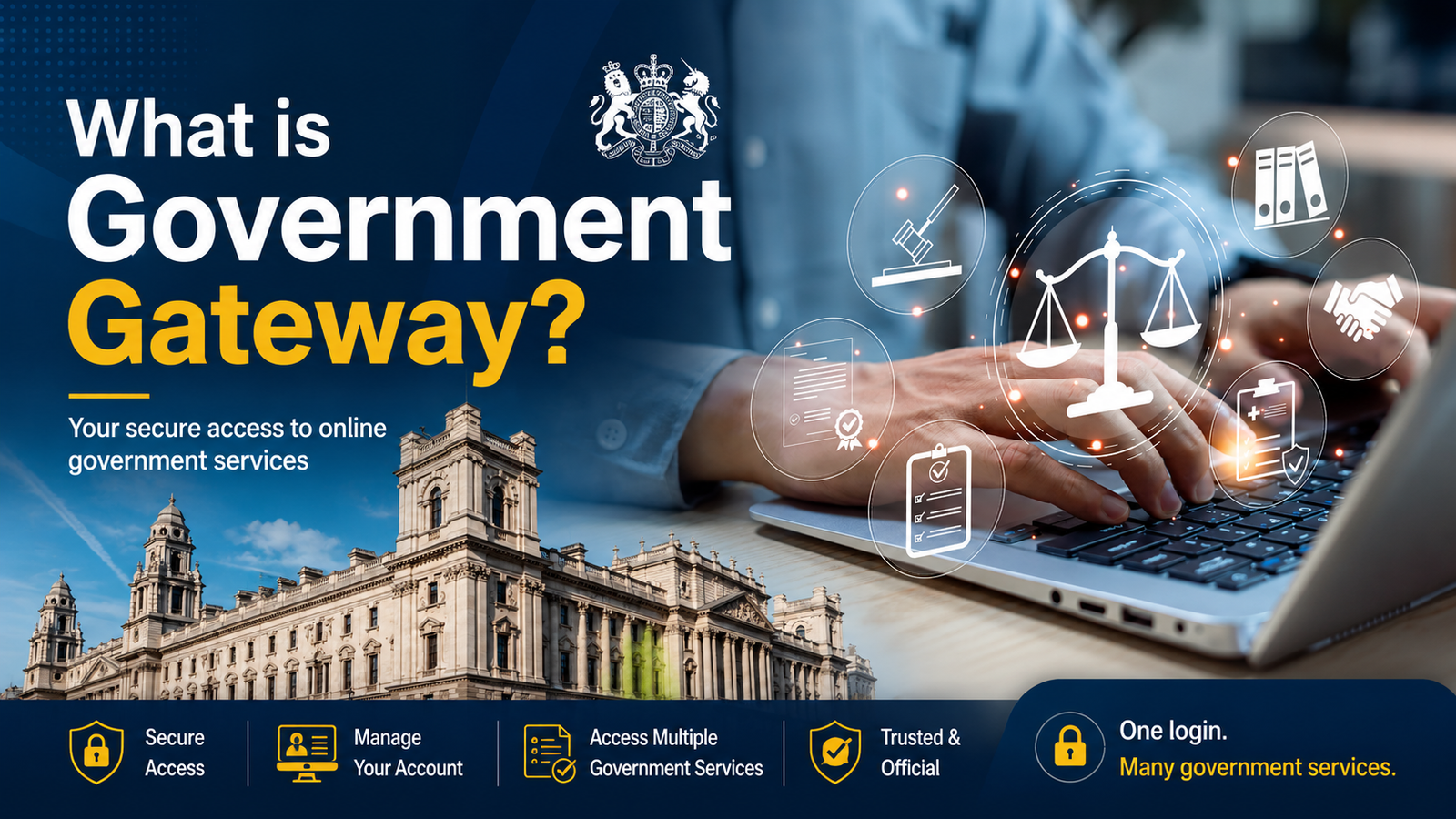
Understanding what is Government Gateway is essential for anyone living or working in the United Kingdom, especially when dealing with taxes, benefits, or a wide range of official government services. Government Gateway is a secure online system that allows individuals and businesses to access various UK government services in one place. It plays a central role in how people interact with departments such as HM Revenue and Customs, the Department for Work and Pensions, and other public sector bodies.
At its core, Government Gateway is designed to simplify access to essential services that were traditionally handled through paper forms, postal applications, or in-person visits. Over time, the UK government has moved many of these services online, and Government Gateway has become one of the key authentication systems supporting this digital transformation.
When people ask what is Government Gateway, they are often trying to understand how to log in to HMRC, how to submit a tax return, or how to manage their personal or business tax records. The system acts as a digital identity verification tool, ensuring that only authorised users can access sensitive information. It is widely used across the UK and remains an important part of the government’s online infrastructure, even as newer systems are gradually being introduced.
In this article, we will explore in depth what Government Gateway is, how it works, why it is used, and how it continues to evolve within the UK’s digital public services landscape. By the end, you will have a complete understanding of its purpose, benefits, and practical applications.
Understanding What Government Gateway Is
To fully answer the question what is Government Gateway, it is important to view it as more than just a login page. Government Gateway is an identity management system that was created to provide secure access to online government services. It allows users to create an account, obtain a unique user ID, and set a password that can be used to sign in to various government platforms.
The system acts as a bridge between users and government departments. Instead of each department requiring separate login credentials, Government Gateway centralises authentication. This means that once a user is registered, they can access multiple services without repeatedly proving their identity from scratch.
Government Gateway is especially associated with tax-related services provided by HM Revenue and Customs. Individuals use it to manage income tax, submit self-assessment tax returns, check National Insurance records, and handle VAT or PAYE if they are running a business. Employers and accountants also rely heavily on it to manage client accounts and corporate obligations.
The system is not limited to tax. It is also used for a variety of other government services, including applications for certain licences, benefit-related services, and pension management. Its flexibility is one of the reasons it has remained in use for so many years.
When considering what is Government Gateway, it is helpful to think of it as a secure digital key that unlocks access to essential public services across the UK.
The History and Development of Government Gateway
The origins of Government Gateway go back to the early stages of the UK government’s digital transformation efforts. As internet usage became more widespread in the late 1990s and early 2000s, there was a growing need to provide citizens with online access to public services. The traditional paper-based systems were slow, expensive, and often inconvenient for users.
Government Gateway was introduced as part of an initiative to modernise public administration. It was designed to create a unified login system that could be used across different departments. At the time, this was a significant innovation, as most government services operated independently and had separate systems.
Over the years, the platform evolved to accommodate increasing demand and changing security requirements. As cyber threats became more sophisticated, Government Gateway introduced stronger authentication measures, improved encryption, and more robust account recovery processes.
The system also expanded its reach. Initially focused on tax services, it gradually became integrated with a broader range of government functions. This expansion reflected the wider trend of digital government services becoming the norm rather than the exception.
In recent years, the UK government has begun transitioning towards a newer system known as GOV.UK One Login, which aims to eventually replace Government Gateway. However, many services still rely on the original system, meaning it remains highly relevant today.
Understanding what is Government Gateway also means recognising its historical importance as one of the UK’s earliest large-scale digital identity systems.
How Government Gateway Works in Practice
.png)
To understand what is Government Gateway in a practical sense, it is useful to look at how it functions behind the scenes. When a user registers for Government Gateway, they are assigned a unique identifier known as a Government Gateway user ID. This ID, combined with a password, allows them to sign in securely.
When a user attempts to access a government service, such as submitting a tax return, the service redirects them to the Government Gateway login page. After entering their credentials, the system verifies their identity and grants access if the details are correct. Once authenticated, the user is redirected back to the service they were trying to access.
In many cases, additional security steps are involved. These may include two-step verification, where a code is sent to a mobile device or email address. This helps ensure that even if someone obtains a password, they cannot easily access the account without secondary confirmation.
Government Gateway also manages user permissions. For example, an accountant may have access to multiple client accounts, while an individual taxpayer will only have access to their own records. This role-based access system helps maintain privacy and security across the platform.
The system operates continuously, providing 24-hour access to services. This is particularly important for businesses that need to manage tax submissions or compliance tasks outside standard working hours.
When people ask what is Government Gateway, the simplest explanation is that it is the secure authentication layer that sits between users and UK government digital services.
Creating a Government Gateway Account
Setting up access to Government Gateway is a straightforward process, but it requires careful attention to detail to ensure security. Users begin by providing basic personal or business information, depending on the type of account they need.
Once the initial registration is completed, the system generates a unique Government Gateway user ID. This ID is extremely important, as it is required every time the user logs in. It is typically stored securely by the user, as it cannot easily be recovered without identity verification.
During the setup process, users are also asked to create a strong password. This password must meet security requirements designed to protect sensitive government data. In addition, users may be prompted to set up recovery options, such as security questions or backup contact details.
For businesses, the registration process may include additional steps to verify the organisation. This ensures that only authorised individuals can act on behalf of the business when dealing with tax or compliance matters.
Once the account is created, users can begin linking it to specific services. For example, linking to HMRC services allows access to tax records, while other links may enable access to different government functions.
Understanding what is Government Gateway includes recognising that the account creation process is designed to balance ease of access with strong security controls.
Security and Data Protection in Government Gateway
Security is one of the most important aspects when discussing what is Government Gateway. The system handles highly sensitive personal and financial information, so robust protection measures are essential.
Government Gateway uses encryption to protect data transmitted between users and government servers. This ensures that information such as passwords, tax details, and personal identifiers cannot be easily intercepted by malicious actors.
In addition to encryption, the system uses authentication mechanisms to verify user identity. This includes password protection and, in many cases, multi-factor authentication. These additional layers of security significantly reduce the risk of unauthorised access.
The platform also incorporates session management controls. This means that users are automatically logged out after a period of inactivity, reducing the risk of someone accessing an unattended account.
From a data protection perspective, Government Gateway operates under strict UK government regulations. These rules ensure that personal data is handled responsibly and in compliance with legal requirements.
Users are also encouraged to maintain their own security practices. This includes using strong passwords, keeping login details confidential, and being cautious about phishing attempts that may try to imitate official government communications.
When examining what is Government Gateway, its security infrastructure is one of its defining features and a key reason why it has been trusted for so many years.
Services Accessible Through Government Gateway
One of the most important aspects of understanding what is Government Gateway is recognising the wide range of services it provides access to. It is primarily associated with HM Revenue and Customs, but its reach extends further into other areas of government.
For individuals, Government Gateway is commonly used to manage personal tax affairs. This includes submitting self-assessment tax returns, checking tax codes, viewing National Insurance contributions, and managing refunds or payments.
For employers and businesses, the system is essential for payroll reporting, VAT submissions, corporation tax management, and other compliance obligations. It is widely used by accountants and financial professionals who manage multiple clients.
Beyond taxation, Government Gateway is also used for accessing certain benefits and pension services. Individuals may use it to check eligibility, update personal details, or manage ongoing claims.
Some licensing and regulatory services also rely on Government Gateway for authentication. This ensures that only verified users can submit applications or access regulated information.
The system’s versatility is a key reason why it remains an important part of the UK’s digital infrastructure. It acts as a universal access point for a wide variety of government services.
When people ask what is Government Gateway, the answer often becomes clearer when they realise how many essential services depend on it.
Benefits of Using Government Gateway
Government Gateway offers several important benefits that have contributed to its long-standing use within the UK public sector. One of the most significant advantages is convenience. Users can access multiple government services through a single login, eliminating the need to create separate accounts for different departments.
Another key benefit is efficiency. By digitising processes that were once paper-based, Government Gateway reduces administrative delays and allows users to complete tasks quickly from any location. This is particularly valuable for businesses that need to meet strict deadlines.
Security is another major advantage. The system is designed to protect sensitive personal and financial information, giving users confidence when managing their government-related affairs online.
Government Gateway also improves accuracy. Digital submissions reduce the risk of errors that are common in manual paperwork. This leads to faster processing times and fewer complications.
Accessibility is another important factor. Users can access services at any time, making it easier to manage responsibilities outside of traditional office hours. This flexibility has made it an essential tool for both individuals and organisations.
Overall, understanding what is Government Gateway also means recognising the practical benefits it brings to everyday life in the UK.
Common Issues and Challenges with Government Gateway
Despite its advantages, Government Gateway is not without challenges. One of the most common issues users face is forgetting login credentials, particularly the Government Gateway user ID. Since this ID is unique and essential for access, losing it can cause frustration.
Another frequent issue involves account recovery. While security is important, the recovery process can sometimes be time-consuming, especially if users do not have updated contact details.
Technical difficulties can also arise, particularly during peak usage periods such as tax deadlines. High demand can lead to slower response times or temporary access issues.
Some users also find the system less intuitive compared to newer digital platforms. As the UK government continues to modernise its services, Government Gateway can sometimes feel outdated in terms of user experience.
Phishing attempts are another concern. Cybercriminals may attempt to trick users into revealing their login details by imitating official communications. This makes awareness and caution extremely important.
When exploring what is Government Gateway, it is important to acknowledge these challenges alongside its benefits.
Government Gateway and GOV.UK One Login
In recent years, the UK government has introduced a newer identity system known as GOV.UK One Login. This system is designed to eventually replace Government Gateway and provide a more modern and unified approach to digital identity across government services.
While Government Gateway has served the UK well for many years, it was developed at a time when digital identity systems were less advanced. GOV.UK One Login aims to address some of its limitations by offering a more streamlined and user-friendly experience.
The transition between systems is gradual, and many services still rely on Government Gateway. This means that users may need to interact with both systems depending on the service they are accessing.
Understanding what is Government Gateway in today’s context also involves recognising that it is part of an evolving digital ecosystem. It remains important now, but its role is slowly shifting as newer technologies are introduced.
The long-term goal is to create a single, secure, and consistent login experience across all government services, reducing complexity for users.
The Future of Government Gateway in the UK
The future of Government Gateway is closely linked to the broader digital transformation of UK government services. As technology continues to evolve, there is a clear push towards more integrated and user-friendly systems.
While Government Gateway is expected to be gradually phased out in favour of newer solutions, it will continue to play a role in the short to medium term. Many critical systems still depend on it, and a full transition will take time.
Future developments are likely to focus on improving user experience, enhancing security, and ensuring seamless access across devices. Mobile compatibility and simplified authentication processes are expected to become increasingly important.
Artificial intelligence and automation may also play a role in future government systems, potentially reducing the need for manual input and improving service efficiency.
Even as systems change, the core purpose behind Government Gateway will remain the same. It is fundamentally about providing secure, reliable access to essential public services.
Understanding what is Government Gateway also means appreciating its role as a foundation for the UK’s ongoing digital evolution.
Conclusion
In conclusion, understanding what is Government Gateway provides valuable insight into how the UK government delivers digital services to individuals and businesses. It is a secure authentication system that enables access to a wide range of important services, particularly those related to taxation, benefits, and public administration.
Over the years, Government Gateway has played a crucial role in modernising how citizens interact with government departments. It has simplified processes, improved efficiency, and made essential services more accessible.
Although it is gradually being replaced by newer systems like GOV.UK One Login, it remains an important part of the UK’s digital infrastructure. Millions of users still rely on it for daily administrative tasks, and its impact on public service delivery is significant.
By understanding what is Government Gateway, users can better navigate government services, manage their accounts more effectively, and appreciate the broader shift towards digital governance in the United Kingdom.
You may also read: Legal Considerations Surrounding amethstreams.com in the UK