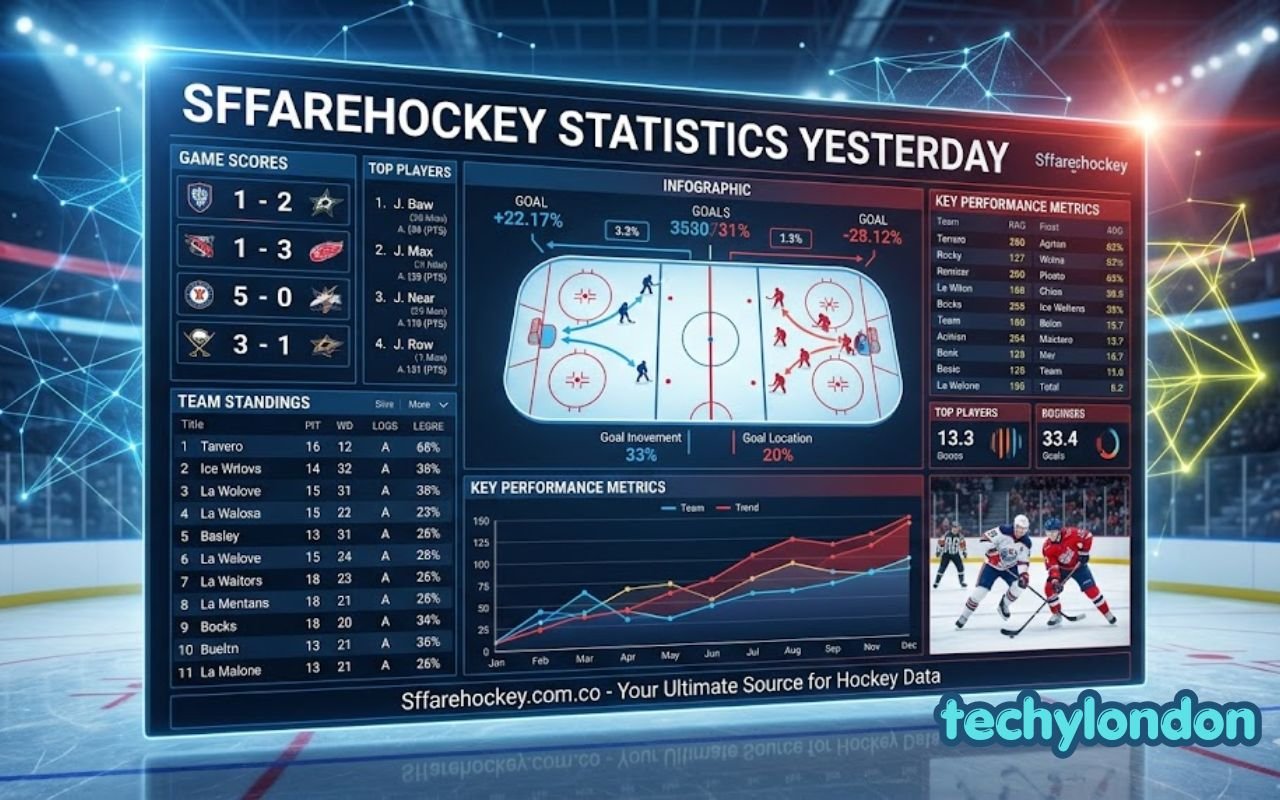
The world of hockey has evolved dramatically over the past decade. Modern fans, analysts, coaches, and sports enthusiasts no longer rely solely on match results to understand performance. Instead, they turn to detailed statistics that reveal the deeper story behind every game. Among the many search terms gaining popularity, sffarehockey statistics yesterday has become an increasingly important phrase for people seeking recent hockey performance data and insights.
When people search for sffarehockey statistics yesterday, they are often looking for the most recent hockey statistics, match performances, player contributions, team trends, scoring records, possession figures, defensive numbers, and overall game analysis from the previous day. These statistics provide a valuable snapshot of what happened on the ice and help fans understand why certain teams won, lost, or performed above expectations.
In today’s data-driven sports environment, statistics are more than just numbers. They provide context, reveal patterns, and offer meaningful insights into team and player performance. Whether you are a casual fan following your favourite club, a fantasy sports participant making lineup decisions, or a serious analyst evaluating trends, understanding hockey statistics from the previous day can significantly improve your understanding of the game.
This comprehensive guide explores everything related to sffarehockey statistics yesterday, including the importance of daily hockey statistics, key performance indicators, player metrics, team analysis, trend identification, strategic applications, and the future of hockey analytics.
Understanding the Meaning of Sffarehockey Statistics Yesterday
The phrase sffarehockey statistics yesterday generally refers to hockey-related statistical information gathered from games played during the previous day. These statistics help provide a clear picture of individual and team performances across various competitions.
Daily hockey statistics typically include scoring totals, assists, shots on goal, save percentages, penalties, possession numbers, faceoff wins, defensive actions, and special teams performance. By examining these figures, fans and analysts can gain a much deeper understanding of game outcomes than they would from simply looking at the final score.
The growing interest in recent hockey statistics reflects a broader trend within modern sports. Supporters increasingly seek immediate access to performance data so they can evaluate results, identify emerging stars, and track team development throughout a season.
As hockey continues to embrace advanced analytics, daily statistical reports have become an essential resource for understanding the sport at every level.
Why Daily Hockey Statistics Matter
Hockey is a fast-paced game where small details often determine outcomes. A team may dominate possession but lose because of poor finishing. Another team may generate fewer scoring chances but capitalise on nearly every opportunity.
Daily statistics help reveal these important details.
By reviewing sffarehockey statistics yesterday, observers can identify performance factors that influenced game results. Statistics allow people to move beyond assumptions and evaluate events based on measurable evidence.
For example, a team that won by several goals may appear dominant on the surface. However, deeper analysis could show that the opposing team generated more shots, controlled possession, and simply suffered from poor shooting luck.
These insights are valuable because they provide a more accurate understanding of actual performance levels.
Daily hockey statistics also help track momentum throughout a season. Teams often experience hot and cold streaks, and statistical trends can reveal whether recent success is sustainable or likely to decline.
Key Categories Found in Hockey Statistics
Modern hockey statistics cover a wide range of performance areas. Understanding these categories is essential when reviewing sffarehockey statistics yesterday.
Goals Scored
Goals remain the most important statistic in hockey. They directly determine match outcomes and often serve as the primary measure of offensive success.
However, goal totals alone do not tell the entire story. Analysts frequently compare goals scored with scoring chances and shot quality to gain a more complete understanding of offensive performance.
Assists
Assists recognise players who contribute to scoring plays. They highlight teamwork, creativity, and playmaking ability.
Players with high assist totals often serve as offensive catalysts who create opportunities for teammates.
Shots on Goal
Shots on goal measure offensive pressure and scoring intent. Teams generating large numbers of shots generally spend more time attacking and creating opportunities.
This statistic is particularly useful when evaluating whether a team’s offensive production aligns with its underlying performance.
Save Percentage
Goaltenders play a critical role in hockey success. Save percentage measures the proportion of shots stopped by a goalkeeper.
A high save percentage typically indicates strong goaltending performance and can significantly influence game outcomes.
Faceoff Performance
Faceoffs determine initial puck possession after stoppages. Winning faceoffs can provide strategic advantages in both offensive and defensive situations.
Daily hockey statistics often include faceoff win percentages to assess effectiveness in this area.
Penalty Statistics
Penalties affect team performance by creating power-play opportunities for opponents.
Analysing penalty data helps identify discipline issues and assess how effectively teams manage pressure situations.
The Rise of Advanced Hockey Analytics
Traditional hockey statistics remain important, but advanced analytics have transformed how the sport is analysed.
Modern hockey analysis increasingly focuses on metrics that provide deeper insights into performance quality.
Advanced statistics included within sffarehockey statistics yesterday may feature expected goals, shot quality assessments, possession metrics, scoring chance differentials, and zone entry success rates.
These measurements help distinguish between sustainable performance and short-term results influenced by luck.
Advanced analytics provide valuable context that traditional box scores often fail to capture.
As a result, many teams now employ dedicated analytics departments to support coaching decisions and player evaluation processes.
Evaluating Team Performance Through Statistics
Team analysis represents one of the most important uses of hockey statistics.
When reviewing sffarehockey statistics yesterday, analysts often focus on overall team performance indicators rather than individual achievements.
Strong team evaluation considers offensive production, defensive effectiveness, possession control, special teams efficiency, and goaltending performance.
A balanced statistical profile usually indicates a competitive and sustainable team structure.
Conversely, teams relying heavily on one area while struggling elsewhere may face challenges maintaining success over a long season.
Daily statistical reviews help identify these strengths and weaknesses early.
Understanding Offensive Metrics
Offensive performance extends beyond simply scoring goals.
Modern hockey analysis examines how teams generate scoring opportunities and whether offensive output reflects underlying performance.
Important offensive metrics include shot volume, scoring chances, expected goals, shooting percentage, and offensive zone possession.
A team producing numerous high-quality opportunities may be performing well even if immediate goal totals remain modest.
Similarly, unusually high shooting percentages may indicate results that are difficult to sustain over time.
These insights help create a more accurate assessment of offensive capability.
Analysing Defensive Performance
Defensive statistics are equally important when evaluating hockey teams.
Strong defence involves more than preventing goals. It includes limiting shot quality, reducing scoring opportunities, maintaining structure, and controlling dangerous areas of the ice.
Defensive metrics often include blocked shots, takeaways, turnovers forced, goals against, and expected goals allowed.
Teams with strong defensive numbers frequently achieve consistent success because they minimise opportunities for opponents.
Reviewing defensive data within sffarehockey statistics yesterday helps identify teams that excel in preventing offensive threats.
The Importance of Goaltending Statistics
Goaltending remains one of hockey’s most influential factors.
A single exceptional performance from a goalkeeper can dramatically alter match outcomes.
Statistics such as save percentage, goals against average, high-danger save rate, and shutouts provide valuable insight into goaltender effectiveness.
Daily statistical reviews often highlight standout goaltending performances that may have been decisive in determining results.
Understanding these numbers helps explain why some teams outperform expectations despite generating fewer offensive opportunities.
Player Performance Analysis
Individual player statistics remain among the most popular aspects of hockey analysis.
Fans frequently examine daily performance reports to track favourite players and identify emerging talent.
Key player metrics include goals, assists, points, shots, ice time, plus-minus ratings, faceoff success, blocked shots, and takeaways.
Advanced metrics may further evaluate player impact through possession statistics and expected goal contributions.
These measurements help distinguish players who consistently influence games from those benefiting from favourable circumstances.
Identifying Emerging Trends
One major benefit of reviewing sffarehockey statistics yesterday is the ability to identify emerging trends.
Statistical patterns often develop gradually before becoming obvious in standings or public perception.
Teams showing improving possession numbers, stronger defensive metrics, or increased scoring opportunities may be poised for future success.
Likewise, declining performance indicators can signal potential struggles ahead.
Trend analysis allows fans and analysts to anticipate developments rather than simply reacting after they occur.
This forward-looking perspective makes statistical analysis particularly valuable.
The Role of Special Teams
Special teams play a crucial role in hockey success.
Power plays and penalty kills often determine outcomes in closely contested games.
Statistics related to special teams include power-play conversion rates, penalty-kill percentages, goals scored with a man advantage, and goals prevented while shorthanded.
Strong special teams performance can compensate for weaknesses elsewhere.
Reviewing daily special teams statistics provides important context for understanding recent results and overall team effectiveness.
How Coaches Use Daily Statistics
Professional coaches rely heavily on statistical analysis when preparing for future opponents.
The information contained within sffarehockey statistics yesterday can influence training sessions, tactical adjustments, player selection decisions, and strategic planning.
Coaches examine performance data to identify areas requiring improvement and reinforce successful approaches.
Statistical evidence helps support objective decision-making and reduces reliance on subjective impressions.
As analytics continue to evolve, data-driven coaching strategies are becoming increasingly common throughout hockey.
The Connection Between Statistics and Strategy
Statistics and strategy are closely linked in modern hockey.
Performance data helps reveal which tactical approaches produce the most favourable outcomes.
For example, teams may analyse zone entry success rates, forechecking effectiveness, defensive coverage patterns, and transition play efficiency.
These insights inform strategic adjustments designed to maximise performance.
Daily statistical reviews provide fresh evidence that teams can use to refine their tactical approaches.
Fan Engagement and Statistical Analysis
Fans have become increasingly sophisticated consumers of sports information.
Many supporters now seek deeper insights than traditional match reports provide.
The popularity of searches related to sffarehockey statistics yesterday demonstrates growing interest in analytical perspectives.
Statistics help fans understand games more thoroughly and engage with hockey on a deeper level.
This enhanced understanding often increases enjoyment by revealing nuances that may otherwise go unnoticed.
As statistical resources become more accessible, fan engagement with analytics continues to expand.
Fantasy Hockey and Daily Statistics
Fantasy hockey participants depend heavily on recent performance data.
Daily statistics help managers evaluate player form, identify breakout candidates, and make informed roster decisions.
Recent scoring trends, ice time changes, shooting volume, and special teams usage can all influence fantasy value.
Because player performance fluctuates throughout the season, daily statistical monitoring provides a competitive advantage.
Fantasy success increasingly depends on understanding and interpreting detailed performance metrics.
Media Coverage and Hockey Analytics
Sports media organisations now incorporate statistical analysis into regular coverage.
Match recaps frequently include advanced metrics alongside traditional summaries.
This shift reflects growing public interest in deeper performance evaluation.
Journalists use statistics to support narratives, explain outcomes, and highlight notable achievements.
As analytical literacy increases among audiences, statistical content continues to play a larger role in hockey reporting.
Common Misinterpretations of Statistics
While statistics are valuable, they must be interpreted carefully.
Numbers can sometimes create misleading impressions when viewed without context.
A player may accumulate points while benefiting from exceptional teammates.
A team may enjoy strong results despite weak underlying performance indicators.
Similarly, short-term statistical fluctuations may not accurately represent long-term ability.
Effective analysis requires combining statistical evidence with contextual understanding.
This balanced approach helps avoid incorrect conclusions and improves decision-making.
Technology’s Influence on Hockey Statistics
Technological advances have revolutionised data collection in hockey.
Modern tracking systems capture detailed information about player movements, puck location, skating speed, passing patterns, and positioning.
These innovations generate vast amounts of data that analysts can use to evaluate performance.
As technology continues to improve, the depth and accuracy of hockey statistics will increase further.
This evolution is transforming how teams, analysts, and fans understand the game.
Predictive Value of Hockey Statistics
One of the most powerful applications of statistics involves forecasting future performance.
Analysts use historical and recent data to estimate likely outcomes and identify trends.
Metrics such as possession rates, expected goals, and scoring chance differentials often provide stronger predictive value than simple win-loss records.
Reviewing sffarehockey statistics yesterday contributes to these predictive models by supplying fresh performance information.
Although no prediction system is perfect, statistical analysis can significantly improve forecasting accuracy.
Building a Better Understanding of Hockey
For newcomers, statistics provide an excellent pathway to understanding hockey more deeply.
Basic numbers such as goals, assists, and shots introduce key performance concepts.
As familiarity grows, more advanced metrics reveal additional layers of insight.
Learning how to interpret hockey statistics enhances appreciation for player skill, team strategy, and game dynamics.
The increasing availability of daily performance data makes this educational process more accessible than ever.
Future Developments in Hockey Analytics
The future of hockey analytics appears extremely promising.
Artificial intelligence, machine learning, and enhanced player tracking systems are expected to generate even more sophisticated performance insights.
Future statistical models may evaluate decision-making quality, tactical effectiveness, and player impact with unprecedented precision.
As these technologies develop, the information associated with sffarehockey statistics yesterday will become increasingly detailed and valuable.
The next generation of hockey analysis will likely offer deeper understanding than anything currently available.
Conclusion
The growing popularity of the search term sffarehockey statistics yesterday reflects the increasing importance of data-driven analysis in modern hockey. Daily statistics provide valuable insights into team performance, player contributions, tactical effectiveness, and emerging trends that traditional match results alone cannot fully explain.
From goals and assists to advanced analytics and predictive modelling, hockey statistics help fans, coaches, analysts, and fantasy participants understand the game on a much deeper level. They reveal hidden patterns, highlight strengths and weaknesses, and support more informed evaluations of recent performances.
As technology continues to transform sports analytics, the depth and quality of hockey statistics will only improve. Daily performance reports will become even more comprehensive, allowing for richer analysis and better decision-making across every level of the sport.
For anyone seeking a clearer understanding of recent hockey action, reviewing sffarehockey statistics yesterday offers a powerful way to move beyond scores and uncover the real story behind each game. By learning how to interpret these statistics effectively, readers can gain a more meaningful appreciation of hockey and stay informed about the latest developments shaping the sport.
You may also read: Key Tportstick Gaming Trends From ThePortableGamer