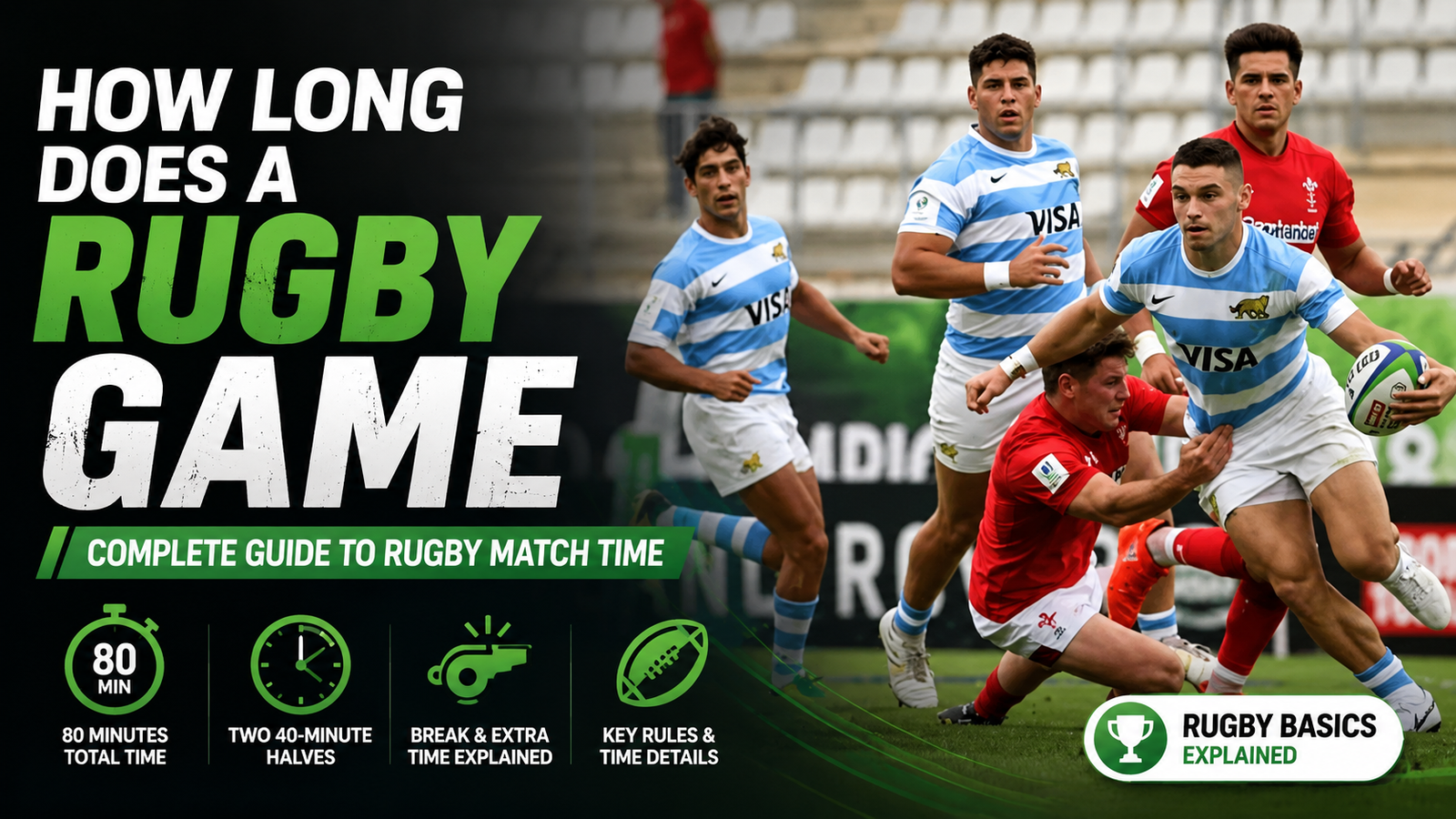
One of the most common questions asked by new fans, parents, and people interested in the sport is: how long does a rugby game last? While the answer may seem straightforward at first, the actual duration of a rugby match can vary depending on the type of rugby being played, the level of competition, stoppages during play, and several other factors.
Rugby is one of the world’s most exciting and physically demanding sports. It combines strength, skill, speed, and tactical awareness in a fast-paced contest that keeps spectators engaged from start to finish. Whether you are watching international rugby, a domestic league match, a school fixture, or a rugby sevens tournament, understanding how long a rugby game lasts can help you enjoy the experience even more.
The official playing time is only part of the story. Match stoppages, injury assessments, video reviews, half-time breaks, and extra time can all affect the overall duration of a rugby event. As a result, the time you spend watching a match is often significantly longer than the official playing clock suggests.
This comprehensive guide explains everything you need to know about how long does a rugby game last, including standard match lengths, differences between rugby union and rugby league, youth rugby timings, extra time regulations, and factors that influence total match duration.
Understanding the Standard Length of a Rugby Match
The most direct answer to the question how long does a rugby game last is that a standard rugby match lasts 80 minutes.
These 80 minutes are divided into two halves of 40 minutes each. Between the two halves, players take a half-time break, which typically lasts between 10 and 15 minutes depending on the competition.
In most professional rugby union competitions, the structure follows a simple format. The first half lasts 40 minutes. After the half-time interval, the second half also lasts 40 minutes. The team with the highest score at the end of the match wins.
Although the official playing time is 80 minutes, spectators should expect the entire event to last between 95 and 120 minutes. This includes pre-match activities, half-time, stoppages, injury treatment, and post-match proceedings.
Rugby Union Match Duration
Rugby union is the most widely recognised form of rugby in the UK. It is played professionally across domestic leagues and international competitions.
When discussing how long does a rugby game last, rugby union usually serves as the standard reference.
A rugby union match consists of two halves of 40 minutes each. The clock runs continuously throughout each half, unlike some sports where the clock stops after every interruption.
The referee may allow additional time at the end of a half if a penalty or scrum is awarded before the clock expires. This means a half can continue beyond the scheduled 40 minutes until the ball becomes dead or a scoring opportunity concludes.
As a result, a rugby union match can occasionally exceed 80 minutes of actual playing time.
International matches, Premiership Rugby fixtures, Six Nations encounters, and Rugby World Cup matches all follow this basic format.
Rugby League Match Duration
Another popular version of the sport is rugby league.
If someone asks how long does a rugby game last and they are referring to rugby league, the answer remains largely the same.
A standard rugby league match also lasts 80 minutes, split into two halves of 40 minutes each.
Despite having the same overall duration, rugby league differs from rugby union in terms of rules, gameplay, and tactics. Rugby league generally features fewer players and faster restarts, which can create a different viewing experience.
Professional rugby league competitions in the UK, including the Super League, use the standard 80-minute format.
Like rugby union, the actual time spectators spend watching the match may exceed the official playing duration because of half-time intervals, injury stoppages, and video referee decisions.
Why Rugby Matches Often Feel Longer Than 80 Minutes
Many first-time viewers are surprised when a rugby match lasts much longer than the advertised 80 minutes.
This happens because the official match clock only measures playing time. The total event duration includes several additional elements.
The half-time interval is one of the biggest contributors. Most professional competitions have a break lasting approximately 10 to 15 minutes.
Injury assessments can also extend the overall match experience. Rugby is a physical sport, and player safety is taken very seriously. Medical staff may enter the field to assess injuries, particularly head injuries.
Television Match Officials, often known as TMOs, can review important incidents such as tries, foul play, or dangerous tackles. These reviews may take several minutes.
Substitutions, disciplinary procedures, and weather-related delays can further increase the overall time spent at a match.
Consequently, an 80-minute rugby match often occupies around two hours of a spectator’s time.
How Long Does a Rugby Sevens Game Last?
Rugby sevens has become increasingly popular thanks to its fast-paced action and inclusion in the Olympic Games.
When asking how long does a rugby game last, it is important to understand that rugby sevens follows a different format.
A standard rugby sevens match consists of two halves lasting seven minutes each. This creates a total playing time of just 14 minutes.
The half-time interval is typically two minutes.
Because of its shorter format, rugby sevens tournaments often feature multiple matches on the same day.
Finals in some major competitions may be slightly longer. Championship finals can feature halves lasting ten minutes each, creating a total playing time of 20 minutes.
The shorter duration results in a faster game with greater emphasis on speed, fitness, and open-field running.
How Long Does a Women’s Rugby Match Last?
Women’s rugby follows the same laws and regulations as men’s rugby at the professional level.
A women’s rugby union match lasts 80 minutes, divided into two halves of 40 minutes.
International competitions such as the Women’s Six Nations and the Women’s Rugby World Cup use the standard format.
As women’s rugby continues to grow in popularity throughout the UK and around the world, spectators can expect the same match duration and structure as men’s professional rugby.
Youth Rugby Match Duration
Youth rugby is designed to suit the age and physical development of young players.
For this reason, match lengths are shorter than those used in adult competitions.
The exact duration varies according to age group and governing body regulations.
Young children may play matches consisting of two halves lasting only 10 or 15 minutes each.
As players get older, match durations gradually increase.
Teenage rugby players often compete in matches lasting between 50 and 70 minutes, depending on their age category.
By the late teenage years, many competitions adopt the full adult match length of 80 minutes.
Parents attending youth rugby fixtures should check local competition rules for specific timings.
School Rugby Match Length
School rugby is a major part of sporting culture throughout the UK.
The duration of school rugby matches varies according to age and educational level.
Primary school matches are generally shorter, helping young players develop skills while reducing physical demands.
Secondary school fixtures often feature longer halves as players mature and become capable of handling greater workloads.
Many school rugby competitions use match durations ranging from 40 to 70 minutes in total.
Senior school teams may play full-length matches approaching the standard 80-minute format.
University Rugby Match Duration
University rugby is highly competitive in the UK.
Most university competitions use the standard adult format of 80 minutes.
Matches are divided into two halves of 40 minutes with a half-time interval.
University rugby often serves as an important pathway for talented players aiming to progress into professional or semi-professional rugby.
As a result, match conditions closely mirror those found in elite adult competitions.
What Happens at Half-Time?
Half-time plays an important role in every rugby match.
The break usually lasts between 10 and 15 minutes.
During this period, players return to the changing rooms where coaches review tactics, discuss performance, and make strategic adjustments.
Medical staff may assess injuries or provide treatment.
Players use the opportunity to hydrate, recover physically, and prepare mentally for the second half.
For spectators, half-time provides a chance to purchase refreshments, visit facilities, and discuss the first-half action.
The half-time interval contributes significantly to the overall event duration beyond the official 80-minute playing time.
Does the Rugby Clock Stop?
One feature that makes rugby unique is its approach to timekeeping.
In rugby union, the clock generally continues running during normal stoppages.
This means time continues while scrums are formed, line-outs are prepared, and certain injuries are treated.
However, referees have the authority to stop the clock for significant delays.
Common reasons include serious injuries, lengthy TMO reviews, or other exceptional circumstances.
This system helps maintain game flow while ensuring fairness and player safety.
Because the clock often continues during routine interruptions, rugby matches maintain a strong sense of momentum throughout the contest.
Extra Time in Rugby
The answer to how long does a rugby game last becomes more complex when knockout competitions are involved.
In league matches and many regular-season fixtures, games simply end after 80 minutes if the scores are tied.
However, knockout tournaments often require a winner.
When this happens, extra time may be played.
In rugby union, extra time usually consists of two periods of 10 minutes each.
This adds 20 minutes of playing time.
The teams switch ends after the first extra-time period.
If the scores remain level after extra time, additional tie-breaking procedures may be used depending on tournament regulations.
Sudden Death and Tie-Breaking Rules
Some rugby competitions employ special procedures to determine a winner after extra time.
One method is sudden death.
Under sudden-death rules, the first team to score wins immediately.
Another possibility is a kicking competition, although this is relatively rare.
Tournament organisers establish specific regulations before the competition begins.
These rules ensure that knockout matches eventually produce a winner while maintaining fairness for both teams.
Rugby World Cup Match Duration
The Rugby World Cup is one of the sport’s most prestigious events.
Pool-stage matches follow the standard 80-minute format.
If a knockout match is tied after 80 minutes, extra time is played.
This usually involves two periods of 10 minutes.
If scores remain level, further tie-breaking methods may be applied according to tournament regulations.
As a result, a Rugby World Cup knockout match can last considerably longer than a regular fixture.
Spectators should be prepared for a lengthy and dramatic contest when elimination is at stake.
How Television Coverage Affects Match Length
Modern rugby broadcasts include extensive pre-match and post-match coverage.
Television viewers often spend much longer than 80 minutes watching a rugby event.
Broadcasters provide team analysis, player interviews, tactical discussions, and expert commentary before kick-off.
Half-time analysis adds further content.
After the match, highlights and reaction segments continue the coverage.
A televised rugby fixture can easily occupy two and a half to three hours of viewing time.
This explains why many fans perceive rugby matches as lasting much longer than the official playing clock suggests.
The Difference Between Playing Time and Event Time
Understanding the distinction between playing time and event time helps answer the question how long does a rugby game last more accurately.
Playing time refers to the official duration of the match itself.
For standard rugby union and rugby league games, this is 80 minutes.
Event time refers to the complete experience from pre-match build-up to the final whistle and post-match activities.
For spectators attending a stadium, event time often ranges from two to three hours.
This distinction is important for anyone planning to attend a match in person.
Why Rugby Uses 80 Minutes
The 80-minute format has been a longstanding feature of rugby.
The duration strikes a balance between physical endurance, tactical complexity, and spectator enjoyment.
A shorter game might not allow enough time for strategic development.
A significantly longer game could place excessive physical demands on players.
Over many decades, the 80-minute structure has proven effective in creating competitive, entertaining contests while maintaining player welfare.
As a result, it remains the global standard across professional rugby.
How Fitness Influences Match Duration
Modern rugby players are among the fittest athletes in sport.
The demands of an 80-minute contest require exceptional endurance, strength, and recovery capacity.
Players may cover significant distances while repeatedly engaging in high-intensity collisions.
The length of a rugby match influences training programmes at every level of the game.
Coaches carefully prepare athletes to maintain performance throughout both halves.
Fitness becomes especially important during the final stages of a match when fatigue can affect decision-making and execution.
How Weather Can Affect Rugby Matches
Weather conditions occasionally influence match duration.
Heavy rain, strong winds, snow, or lightning may cause delays.
In extreme situations, matches can be temporarily suspended.
Player safety remains the priority when adverse weather creates dangerous conditions.
Although such delays are uncommon, they can extend the total event duration well beyond normal expectations.
Fans attending outdoor matches should always be prepared for changing weather conditions.
The Experience of Watching Rugby Live
Watching rugby in person provides a unique perspective on match duration.
The atmosphere, crowd engagement, and live action often make the time pass quickly.
Many spectators are surprised by how rapidly an 80-minute match seems to unfold.
The continuous nature of rugby creates sustained excitement with relatively few lengthy interruptions.
Combined with pre-match entertainment and half-time activities, attending a live rugby match becomes a memorable experience that extends beyond the official playing time.
Common Misconceptions About Rugby Match Length
Several misconceptions surround the topic of how long does a rugby game last.
Some people assume rugby matches are significantly longer than football matches. In reality, both sports generally feature 90 minutes of scheduled playing time or less.
Others believe the clock stops after every interruption. In rugby, the clock usually continues running during routine stoppages.
Another common misunderstanding is that all forms of rugby last 80 minutes. Rugby sevens clearly demonstrates that different formats can have very different match durations.
Understanding these distinctions helps new fans appreciate the structure and flow of the game.
Tips for First-Time Rugby Spectators
Anyone attending their first rugby match should allow sufficient time for the complete experience.
Arriving early provides an opportunity to find seats, explore the venue, and enjoy the pre-match atmosphere.
Expect the overall event to last approximately two to three hours.
Familiarising yourself with basic rugby rules before attending can also enhance enjoyment and understanding.
Knowing that the official match lasts 80 minutes helps set realistic expectations while recognising that additional factors may extend the overall event.
Conclusion
If you have ever wondered how long does a rugby game last, the simple answer is that a standard rugby union or rugby league match lasts 80 minutes, divided into two halves of 40 minutes each. However, the full picture is more detailed. Half-time intervals, injuries, video reviews, substitutions, and other stoppages mean that the total event usually lasts between 95 minutes and two hours, with televised coverage often extending even longer.
Different forms of rugby have different match lengths. Rugby sevens typically lasts just 14 minutes, while youth and school rugby use shorter formats appropriate for player development. Knockout competitions may also include extra time when a winner must be determined.
Understanding match duration enhances the experience for players, parents, supporters, and newcomers alike. Whether you are attending a local club fixture, watching the Six Nations, following the Rugby World Cup, or enjoying a rugby sevens tournament, knowing exactly how long a rugby game lasts allows you to appreciate the structure, strategy, and excitement that make rugby one of the UK’s most beloved sports.
You may also read: How to Change FPL Name Step by Step